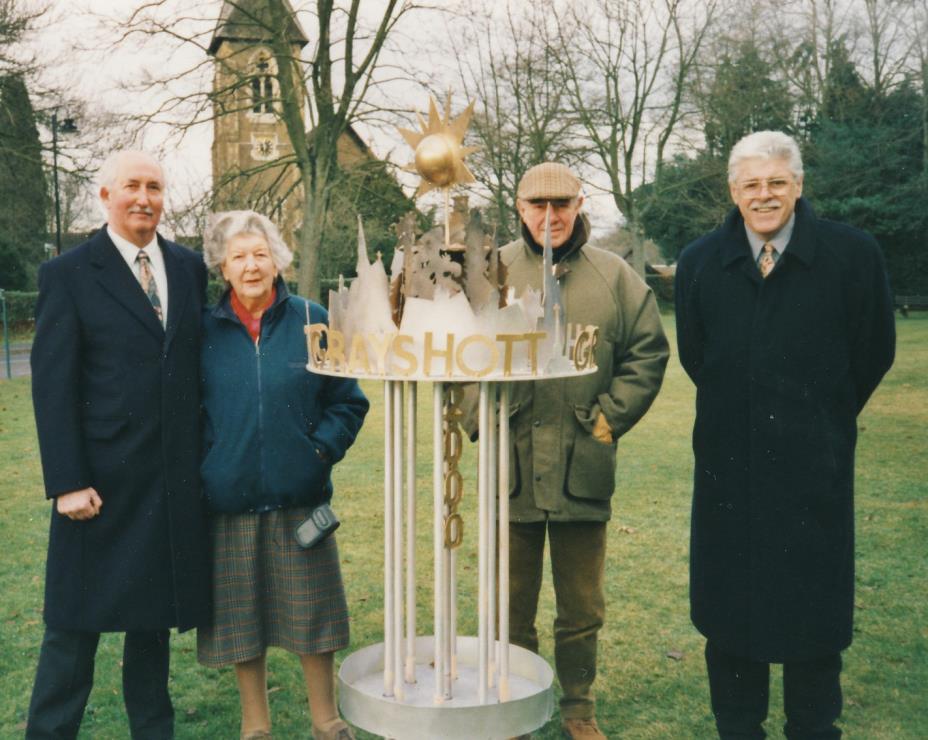
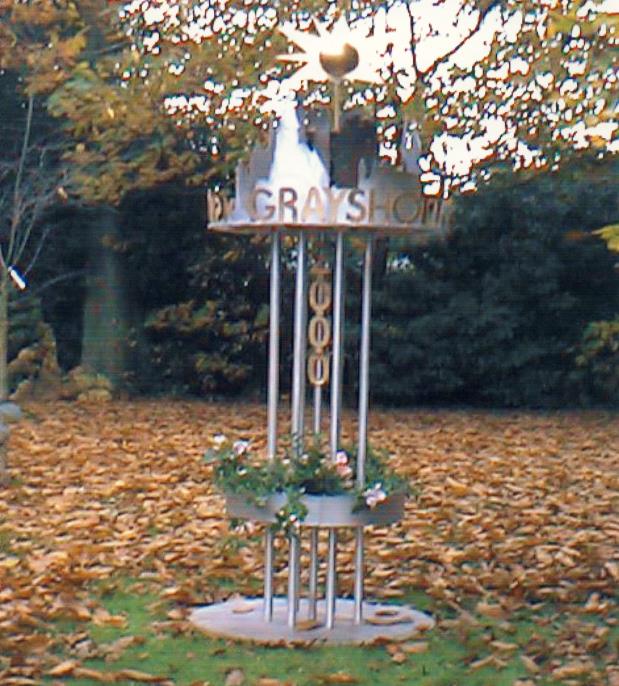
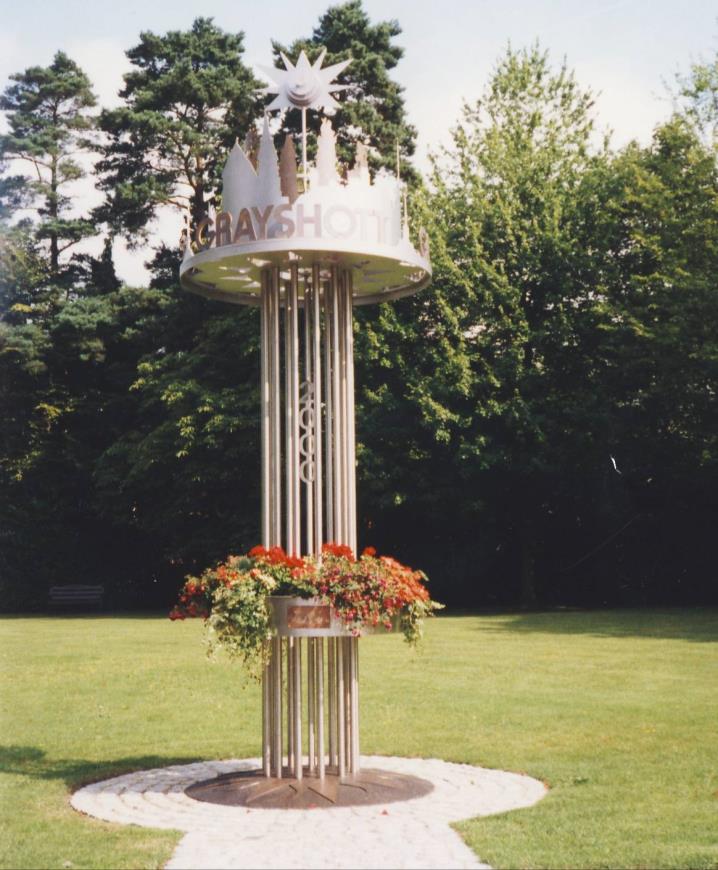
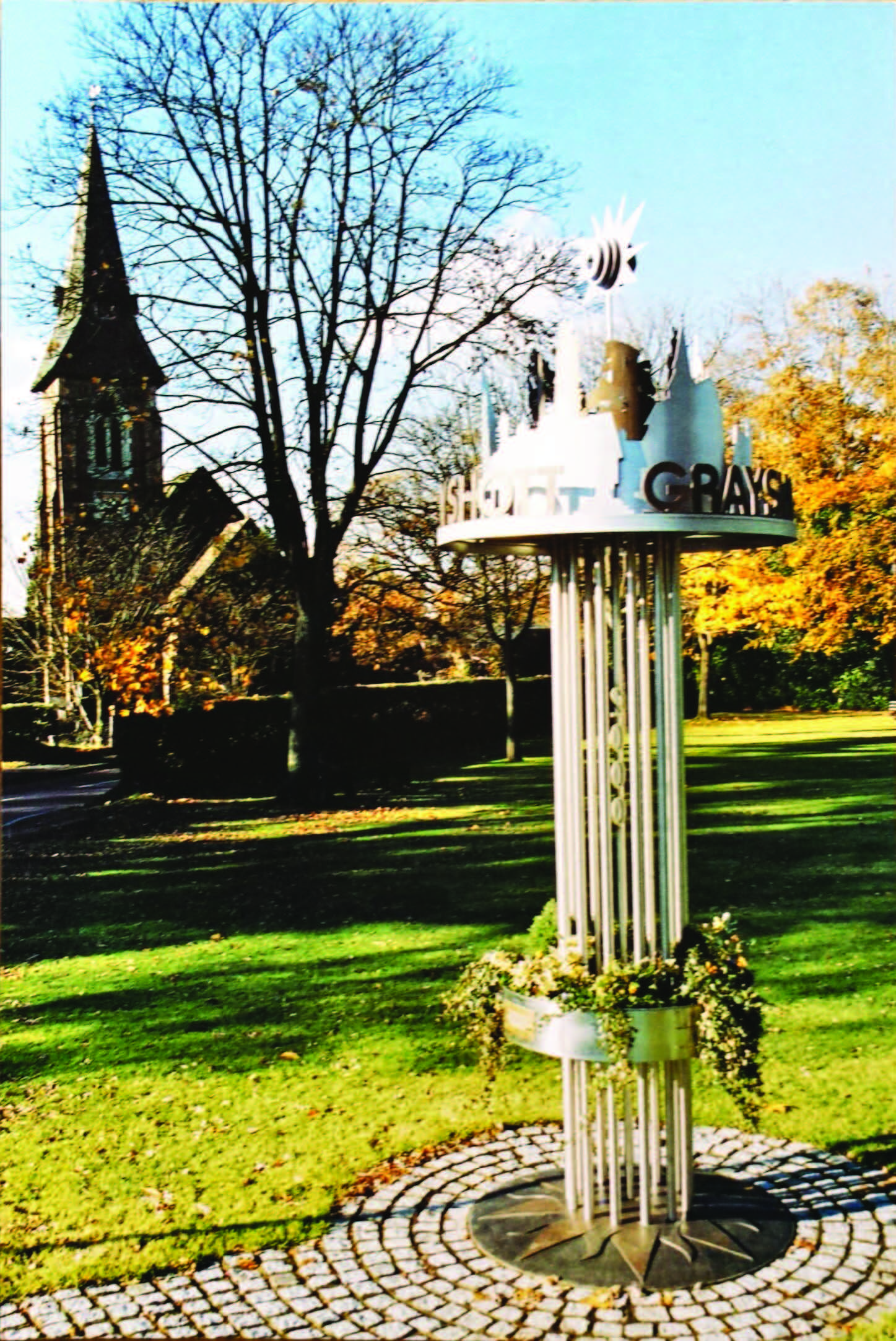
Grayshott’s Millenium Sign sits proudly in the middle of the Village Green and is a noticeable feature of the village for residents and visitors alike. The following narrative explains how the Millenium sign came to be comissioned for the village and was originally published as a booklet by Woodyhide Productions in 2020.
Grayshott Parish Council would like to extend its thanks to the members of the Millenium Committee for their efforts in making the millenium sign a reality.
This is the story of how a group of local residents formed a Committee to organise a worthy celebration for Grayshott village to mark the year 2000. Named “The Millennium Committee”, each member appeared automatically to fall into the tasks for which their expertise was best suited, and over the two years they worked together, their projects were twofold.
Firstly, they organised a truly magnificent party in the village which provided activities to give pleasure to every section of the community and to all ages. But whilst this was transient, (but very memorable), they also provided Grayshott with a Village Sign to mark the new Millennium. It stands proudly on the village green, its site care fully chosen not to impede the use of the green and its metals selected to stand the test of time.
Hopefully , future generations will appreciate why it features the silhouettes of St Luke’s Church and The Fox & Pelican whose centenaries coincided with the Millennium.
The Formation of the Millennium Committee
In the early months of 1997, the Parish Council raised the issue of how the new Millennium should be celebrated in Grayshott. At the Parish Assembly held in April that year, they put forward their initial ideas, which were to provide floodlighting for the War Memorial and to organise a “permanent feature” within the village.
The meeting was well attended and a lively discussion took place, during which a suggestion was made to hold a celebratory village party. This was greeted with great enthusiasm, with several people offering to help organise it.
Subsequent discussions within the Council led to the Chairman writing to Pam McNicol, who had initiated the idea of a party, asking her to form a Committee to organise it. Her immediate reaction was to approach Phil Bates, Managing Director of Grayshott Pottery, and seek his advice and help. He expressed great interest in the project, but whilst both he and Pam were willing to serve on the Committee, neither wished to be Chairman.
In May 1998, the Parish Council appointed Ferris Cowper (a Council Member) to chair the Committee, to be known as the Grayshott 2000 Committee. With the generous offer of a permanent venue for all meetings at the Pottery from Phil Bates, the first meeting took place on Monday 27 July 1998.
Their brief was twofold:
- To organise a Village Party.
- To consider ideas that would give the village a permanent memorial to the Millennium.
The members of the Committee were chosen with care and forethought, based on their links with village activities and their personal acumen. To the initial three members — Ferris Cowper, Phil Bates and Pam McNicol — Julia Norman, Sara Maynard, Paul Barnett, Lionel Cross, Julia Goble, Debra Gibbs and Sue Ridout were added. By September, four more members agreed to join the Committee: Ann Myers, Christine Vardy, Jan Harbon, Russell Cupitt and Harry Murphy. Sarah Maynard offered to act as Secretary.
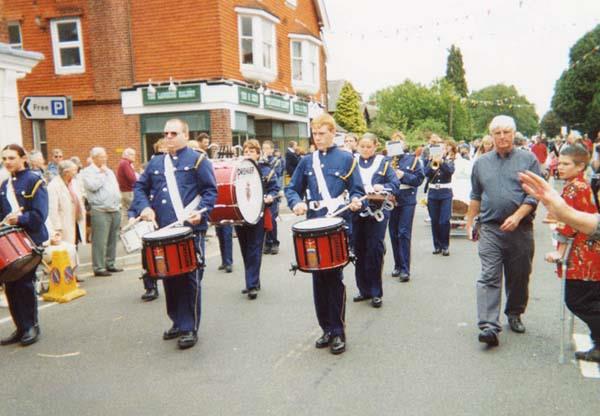
Plans were soon made for what would be described as “the biggest community event in the living memory of our village”, to be held on the midsummer weekend of 24 and 25 June.
Ideas flowed — street entertainments, stalls, bands, a hog roast, involvement of local businesses (especially the Fox & Pelican and local restaurants), dancing in the street, a Carnival Queen heading a carnival procession, etc.
The Chairman said that the guiding principles should be:
- Fun
- Community
- Commemoration
- Inclusive participation for all
- Reflection on the village’s past and looking forward to the future
A significant item was added to the agenda of the meeting held on 19 October. Russell Cupitt of Visual Assets produced two designs for a logo that could be used in conjunction with all events leading up to the Millennium.
One design was in monochrome and the other in two colours. The Committee studied both designs and were delighted with the latter, which showed a silhouette of the village outline backed by a rising sun with the words “Grayshott millennium”. Their reservations were that the outline should show more clearly the two main buildings in the village — the Church, consecrated as the Church of St Luke by Dr Davidson, Bishop of Winchester, on St Luke’s Day 1900, and the Fox & Pelican public house, opened the previous year (1899) by Mrs Randall Davidson, wife of the Bishop of Winchester. It was also thought that the figures 2000 would be a clearer image than the words “Grayshott Millennium”.
Russell Cupitt brought the modified design to the meeting on 23 November, and this was greeted with enthusiasm and gratitude, since Russell wished no payment and promised to produce the logo on file or hard copy for the Committee to use as required.
In no time it became the symbol of all events which would lead up to midsummer weekend. It was recognised by all members of the village and
it signified the celebrations of the Church and the Fox & Pelican centenaries which coincided with the new Millennium.
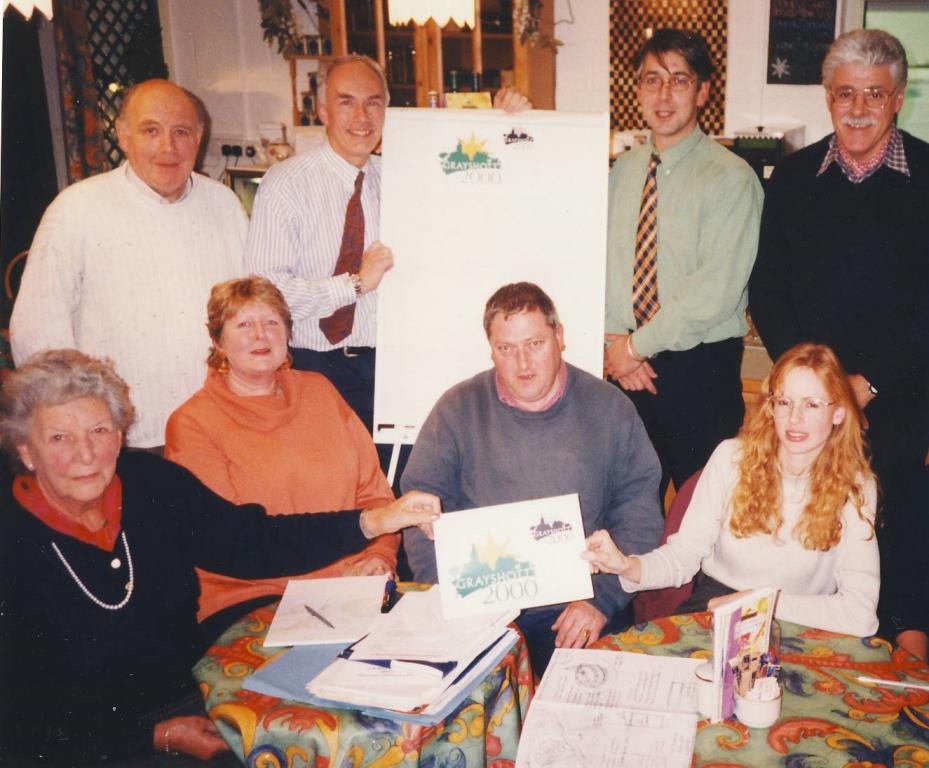
The Committee approves the design
L-R Back Row Harry Murphy, Ferris Cowper, Russell Cupitt, Phil Bates
L-R Front Row Pam McNicol, Ann Myers, Lionel Cross, Sara Maynard

The Grayshott 2000 Logo designed by Russell Cupitt
The Village Millennium Sign
By the end of 1998, the members of the Millennium Committee had automatically divided into groups, each one looking at a specific aspect of the planned celebrations. Ideas were put forward for events to take place in the spring prior to the midsummer weekend — largely as fundraisers, but also to prepare the village for what was to come. With the proposed carnival procession, the need for the road to be closed was addressed, the village hall was booked for indoor events, and insurance and police coverage were arranged — nothing was overlooked.
At the same time, ideas for the permanent memorial were submitted to the Committee. These were listed as follows:
- A fountain on the village green.
- A path of bricks to be laid around the village green, each brick bearing the name of a resident of Grayshott in the year 2000.
- A memorial garden with a pond.
- A memorial path and paved centrepiece in the shape of a maze or spiritual spiral.
- A gazebo.
- A specially commissioned sculpture.
Of these, numbers 2 and 4 attracted the greatest interest. Phil Bates, Russell Cupitt and Sarah Maynard investigated the cost of suitable bricks — suitable both for engraving with names and for providing a substantial path.
At the first meeting of the New Year, on 11 January 1999, Russell Cupitt produced a detailed plan for a maze with a raised bronze centrepiece one metre across, with an overall size of four to five metres. He had approached a firm specialising in paved areas in the shape of mazes; they had visited the site and shown great interest in the project.
Phil Bates contacted Selborne Brickworks near Alton to ask if they would manufacture named bricks. They produced numerous samples, and the Committee discussed how they could be placed in a suitable design for a path.
Subsequently, Phil supplied the firm with a set of letters to stamp into the wet clay before firing. This enabled samples to be made for the Committee to review. Lionel Cross suggested that the first brick should bear the name of the youngest member of the village, and the last brick at the end of the path should bear the name of the oldest. As Phil continued his search for suitable bricks, concerns arose about how the project would be funded and how the names would be chosen.
The Committee realised the importance of producing plans for these ideas to be displayed at the Annual Parish Assembly in April, and of inviting those present to vote for the preferred design.
In the weeks that followed, doubts were expressed about the feasibility of a brick path. Tree roots surrounding the village green meant that the path would have to be sited nearer the centre, reducing the grassy area currently used as a play space. The choice of residents eligible to have their names on a brick also posed a problem. As news of the scheme spread, names were put forward for deceased family members as memorials — which had not been the intention.
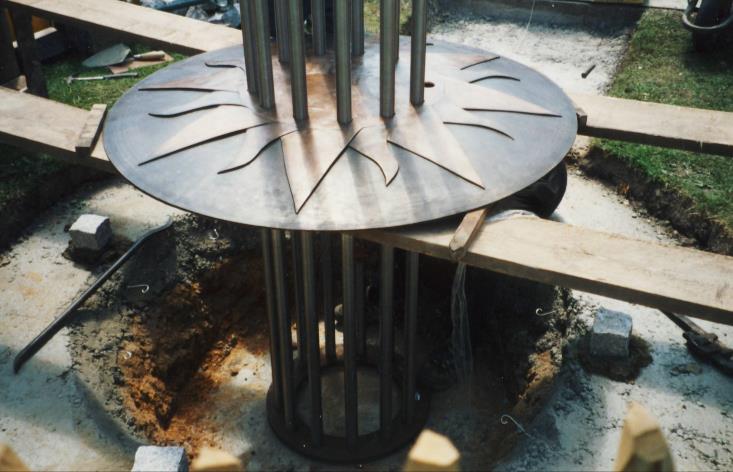
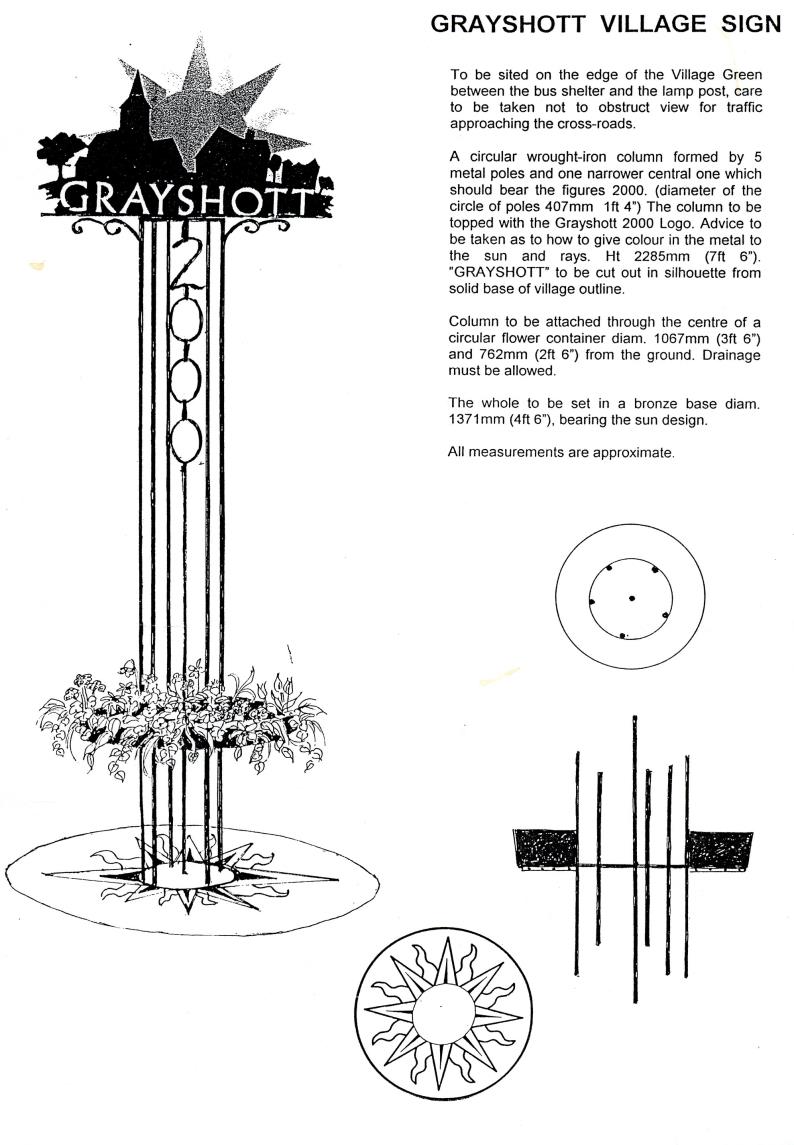
Concerns were also raised about the upkeep of a maze and its visual impact when viewed from the road. It was at this point that Pam McNicol produced a rough drawing of a village sign. She based her design on Russell Cupitt’s logo, now in use on all correspondence, publicity and pottery souvenirs. It included silhouettes of St Luke’s Church, the Fox & Pelican, and three indigenous village trees, mounted on a circle that would top a column of metal poles. These would include a central pole bearing descending figures of 2000, and a circular tray for plants at an agreed height. The whole structure would be fixed to a copper base featuring a sun design.
The Committee agreed that this design should be submitted with the others to the Parish Assembly on 9 April. Its main criteria were that it should be high enough to make an impact from the road at all angles, that it should be suitably landscaped on a site that did not encroach on the village green, and that it should be constructed from the highest‑quality metals to ensure no risk of rusting or corrosion.
At the Parish Assembly, the Millennium Committee staged a strong display of the proposed designs, and great interest was shown by all those present. A vote was taken and, by a large majority, the design for the village sign was chosen. This had also been the preference of the Millennium Committee.
With the decision now taken, Pam produced a more detailed drawing which, though still an “artist’s impression”, showed a more three‑dimensional design. The components of the circle now showed three churches, three pubs, and three GRAYSHOTTs, interspersed with silhouettes of the war memorial and the trees. This ensured the design would be visible and meaningful from all angles.
Before any approach could be made for its construction, however, a proper architectural drawing would be needed.
In October Phil Bates issued a statement “from the original design presented to the parish council a unique and more ambitious design has evolved which will be a most worthy celebration for the millennium in Grayshott.
Original design submitted to the Committee by Pam McNicol

Revised design to give 3-dimensional effect
The Construction of the Chosen Design
The choice for the Grayshott village memorial to mark the Millennium had been made, and the Committee was now faced with the realisation that there were precisely fourteen months before it had to be installed and ready to be unveiled during the celebrations planned for the midsummer weekend.
With no time to be lost, Pam McNicol wrote to several wrought‑iron firms in Guildford, Worplesdon, Farnham and Haslemere. Two of these firms were not interested. Phil Bates and Pam visited the one in Guildford and, although they were impressed with the work carried out there, they made the final decision to choose the well‑known Mr J. F. C. Masterton of The Haslemere Forge Ltd in Haslemere.
However, before he could proceed, it was necessary to produce a 3D architectural drawing of the design. For this, Phil Bates contacted John Jenvey, an artist who lived in Grayswood. John visited the site where the sign was to be erected and made several drawings of St Luke’s Church, the Fox & Pelican, and the trees bordering the green.
He then made a model of the top of the design, cutting the profiles of the church, the pub, the trees and the word GRAYSHOTT — all in threes — from hardboard. He placed these around two connecting circles, fixing a rubber ball to represent the sun, with cardboard sunrays in the centre. The model was made at half the size of the intended final piece, but now in a three‑dimensional form. It gave a far more realistic idea of how the sign would look.
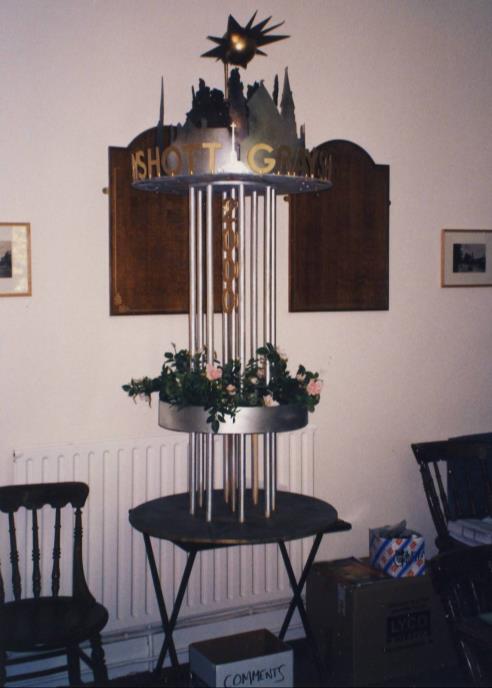
As this model represented only the top section, Phil Bates felt it was necessary to make a complete model — still at half size — before presenting it to the Parish Council for approval. He undertook this himself, producing an excellent model using wooden dowelling and hardboard. He sprayed the poles and flower tray silver, the base bronze, and the sun gold. This proved a vital and worthwhile exercise, making it easier for the Parish Council to gain an overall impression of the final sign.
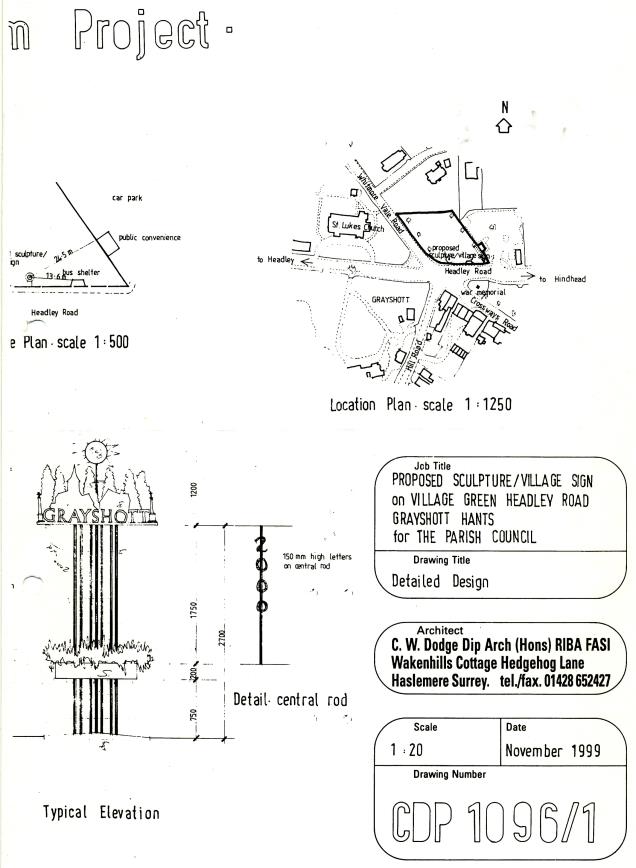
At the same time, it was equally urgent to apply for planning permission from East Hampshire District Council to ensure there would be no delay in the erection of the sign. For this, a detailed architectural plan of the sign and its site on the village green was required.
Who better to carry this out than Mr Colin Dodge, Chartered Architect, who practised in Haslemere and had a lifelong interest in Grayshott, having been born and raised in the village. Colin produced exactly what was required and submitted it to the Council with the formal request for planning permission. Despite the many hours of meticulous work involved, he refused any payment, speaking of his interest in the project and his love for Grayshott.
On 4 October, Phil Bates reported to the Committee that he had made a large model of the proposed sign, which gave a good idea of how it would look. He intended to take it to the next meeting of the Parish Council for their approval. Although he knew the model was not at the correct height, he recognised the importance of judging how tall the sign should be to ensure maximum impact when seen from a distance.
It was agreed that a site meeting should be held on the village green, during which a pole with a crossbar would be held aloft so that the correct height could be assessed.
This meeting took place on 15 December, attended by Phil Bates, Pam McNicol, John Jenvey, John Masterton and Colin Dodge.
Phil Bates put his model before the Parish Council, and it was approved by all those present.
In January 2000, Pam McNicol reported to the Council that the project was in hand and that a deposit had been paid to the Haslemere Forge. She was also aware that the Council were, at this time, keen to have the names of everyone living in the village inscribed on the sign. She pointed out that this would add considerably to the cost, would create difficulties if names were omitted, and would require lettering so small as to be illegible. It was agreed that this should not be done.
Detailed discussions with Mr Masterton in early January were now of vital importance.
Bearing in mind the initial guidelines for the sign, the following remained major considerations:
- Durability — it should be made of materials that would last without maintenance for 100+ years and be constructed by experts in metalwork.
- Structural safety — it should be sound and meet all safety standards.
- Visibility — it should be eye‑catching from all sides.
At a meeting at the Haslemere Forge on 14 January 2000, decisions were taken regarding the types of metals to be used, and John Masterton produced samples. To create variety within the design:
- Bronze and stainless steel were chosen for the buildings.
- The letters, war memorials, top base and trough would be in stainless steel.
- The trees would be in satin stainless steel.
It was agreed that an extra skirt should be added around the base of the top section, constructed in thicker steel to provide additional stability.
Later in January, on the advice of Colin Dodge, the number of poles was increased to thirteen, and he stressed that they should be set at least 24 inches into concrete. The additional rods were required to satisfy a byelaw ensuring child safety by reducing the gaps between them, preventing the risk of a child’s head becoming trapped.
Official planning permission was received by Colin Dodge on 14 January from East Hampshire District Council.
Meanwhile, Phil Bates had contacted Peter Norman of Light Lines, electrical suppliers in Grayshott, who submitted details of two possible methods for lighting the sign and supplying electricity. Phil had also discussed the landscaping with Lindsay Clark Brothers, landscape contractors in Churt, who agreed to undertake the work.
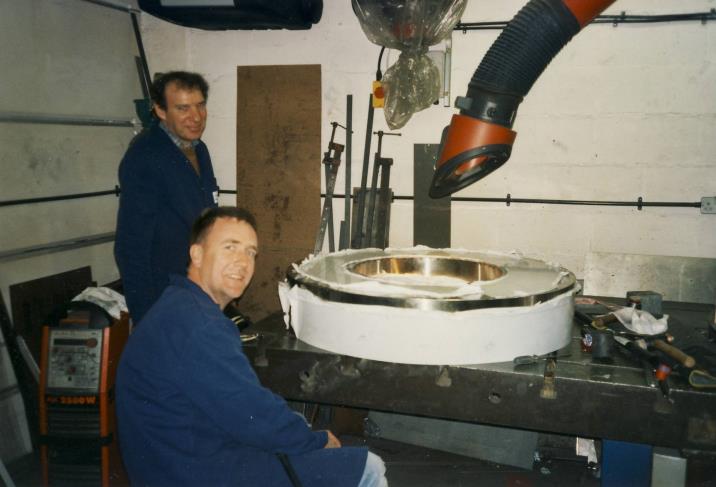
On 24 February, Phil and Pam accompanied Mr Masterton to a foundry in High Wycombe, supposedly to approve a prototype of the bronze sun base. However, on arrival they discovered that it had already been completed and was there before them to view. It was, in fact, a wonderful surprise, and its domed bronze sun was most impressive.
As the weeks passed, more and more work progressed. Detailed plans for Lindsay Clark’s groundwork were produced and, with two or three press reports featuring photographs, interest within the village began to grow.
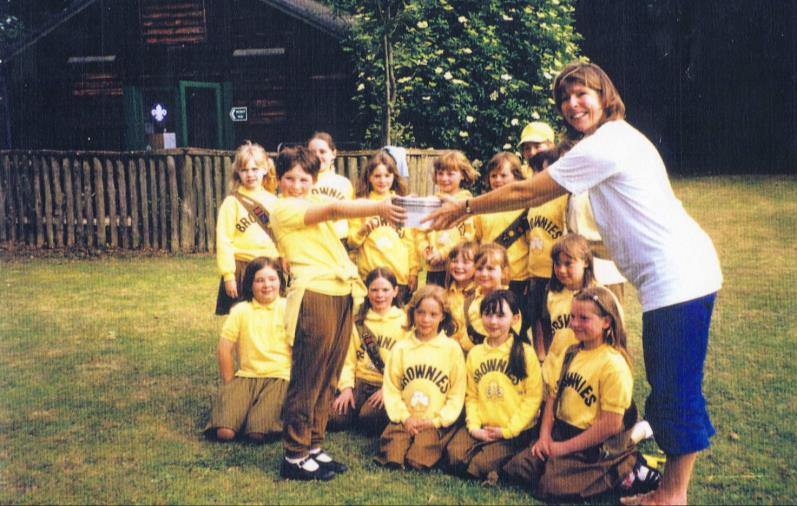
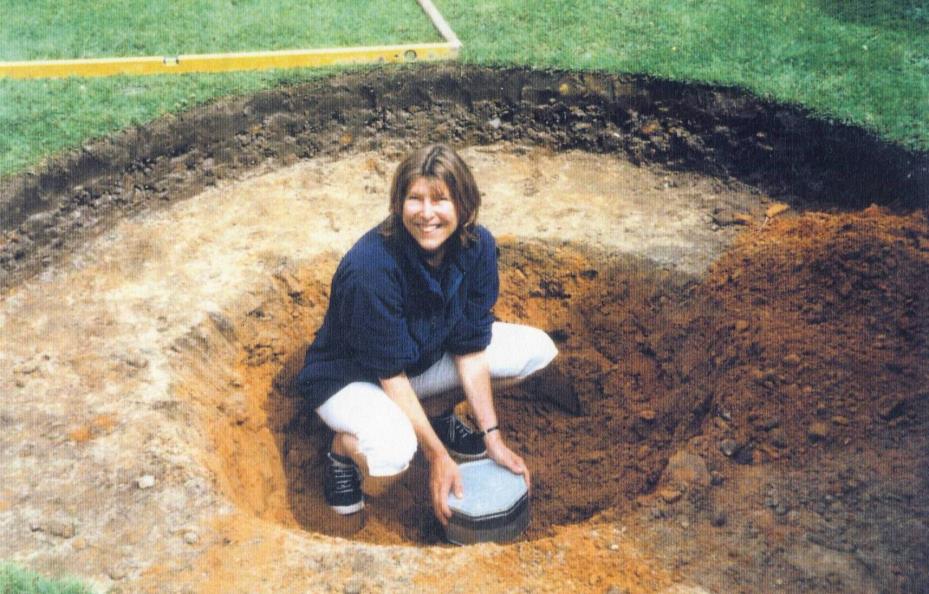
In early April, the Brownies and Beavers requested permission to plant a capsule to be buried beneath the sign. This was agreed, to take place at a suitable moment while the groundwork was underway. Meanwhile, the sun base had been transported from High Wycombe to the Haslemere Forge, and Mr Masterton had begun work on the components of the sign.
Time was now becoming a concern. Phil wrote to Mr Masterton reminding him of the all‑important date for the unveiling. On 8 May, Phil reported that he and Pam had met with Mr Masterton, who had cut out the profiles while working in conjunction with County Carding Engineering Company in Lindford who made it possible that the Millennium sign would be made in time for the unveiling date.
All components were now ready to be assembled, and Lindsay Clark Bros were scheduled to begin the groundwork on 16 June.
The method of floodlighting was now finalised. It was agreed that the best option was to use the existing lamppost positioned a few feet away as the base for the light, which would be focused onto the sign. This lamppost was already at the correct height. Annual maintenance would be the responsibility of the County Council, who would also handle any planning matters. This approach meant there would be no need to dig up the road or pavement.
However, as a precautionary measure — despite the extra cost — Phil proposed that it would be wise to run an earth cable buried along one side of the sign, long enough to reach the public toilet block by the car park, which would provide an alternative source of power. At the same time, it was agreed that one of the poles in the design should be hollow so that the cable could be inserted through it. This would allow for far more effective lighting in the future, but at the present time additional funds would be required to dig across the green to connect the cable.
The sign was earthed through a lightning conductor as an extra safety measure.